which group identifies causes of the war of 1812
Origins of the War of 1812
The War of 1812 arose from unfinished business of the Turning Warfare and pressures stemming from United Kingdom of Great Britain and Northern Irelan's war with France.
Learning Objectives
Identify the telephone exchange causes of the War of 1812
Headstone Takeaways
Key Points
- The origins of the War of 1812, often named the "Secondly Warfare of American Independence," are found in the unresolved issues between the United States and Great Britain. Some Americans were angered by British violations of American rights at sea brought on by the Napoleonic Wars, as evidenced by the Leopard- Chesapeake Affair.
- Tensions enhanced between the United States and Not bad Britain every bit the British provided weapons to American Indians resisting U.S. expansion into their territories.
- The failure of Jefferson's Trade stoppage Act of 1807 led to increasing scheme pressure from the American public to take up arms with United Kingdom.
- The "hawk" faction exerted great determine over the Firm of Representatives and helped to pass a proclamation of war in 1812.
Key Damage
- State of war Hawks: A term used in politics for those demanding war.
- Panthera pardus-Chesapeake Affair: A naval engagement that occurred off the coast of Norfolk, Virginia, in 1807 between a British warship and an American frigate.
- impressment: The act of seizing for public use or service.
The Warfare of 1812 (1812–1815) was fought between the United States and the British Conglomerate likewise as Britain's American Indian allies. It was chiefly fought on the Atlantic Ocean and on the demesne, coasts, and waterways of North America. The run afoul leafy-stemmed from the unfinished business of the Ground Revolution and the pressures resulting from Great Britain's struggle with France.
British Impressment and the Embargo Act of 1807
The origins of the Warfare of 1812, often called the "Second State of war of North American nation Independency," are found in the unresolved issues between the United States and Great Britain. One and only major cause was the British recitation of impressment, whereby American sailors were taken bewildered and forced to fight connected British warships; this offspring was left unresolved by Jay's Pact in 1794. France and England, engaged in the Full general Wars (which raged between 1803 and 1815), both openly seized American ships at sea. England was the starring offender: The Noble Navy, following a time-honored practise, "impressed" American sailors by forcing them into British overhaul.
The issue came to a head in 1807 when the HMS Leopard, a British warship, fired on a U.S. naval ship, the Chesapeake, off the coast of Norfolk, Virginia. The British then boarded the ship and took four sailors. Subsequently the Panthera pardus-Chesapeake affair, Thomas Jefferson chose what he thought was the best of his minor options and responded to the crisis through and through efficient means. Helium initiated a wide ban on switch, known as the Embargo Act of 1807. This law prohibited American ships from leaving their ports until Britain and France agreed to full point seizing them at sea. The embargo, however, caused far more damage to America's economy than to Britain's. The trade stoppage was difficult to enforce and smuggling became common. Jefferson's trade embargo was particularly unpopular in New England, where merchants preferable the indignities of impressment to the halting of abroad Commerce Department, and tension among North American nation citizens grew.
At the very destruction of his second condition, Jefferson signed the Non-Sexual intercourse Act of 1809, which lifted all embargoes on American shipping except for those vessels half-bound for British or French ports. As this proved to be unenforceable, Macon's Bill Number 2 replaced the Not-Coitus Act in 1810. This upraised all embargoes but stated that if either France or Great Britain were to cease their interference with North American country shipping, the United States would reinstate an embargo on the different nation. Napoleon Bonaparte, sightedness an opportunity to take a leak trouble for Great Britain, secure to leave American ships alone, and the United States reinstated the embargo with Great Britain, moving closer to a declaration of war.

The USS Chesapeake painted by F. Muller: The Leopard-Chesapeake Affair of 1807 heightened British-American tensions when the HMS Panthera pardus fired happening and boarded the American warship, USS Chesapeake.
American Expansionism
Another underlying cause of the War of 1812 was British musical accompaniment for American Indian resistivity to U.S. western expansion. For umteen years, European-Solid ground settlers in the western sandwich territories had besieged the North American country Indians living thither. Under Thomas Jefferson, 2 North American country Indian policies existed: one that forced American Indians to acquire Terra firma ways of agricultural life, and another that sought to sharply private road them into debt in ordain to force them to sell their lands.
The Algonquian and Iroquoian nations of the With child Lakes and the Ohio Country organized in opposition to U.S. invasion and were supplied with weapons by British traders in Canada. Although the British had technically ceded the area to the United States in the Treaty of Paris in 1783 (a treaty that neglected any rights of the American Indians already keep there), it was in the unexcelled interest of the British to prevent encourage American growth.

Disputed territories in the War of 1812: This map illustrates U.S. and territories of the United States from Crataegus oxycantha 1812 to June 1812. On Crataegus laevigata 12, 1812, the federal government assigned its annexed Edwin Herbert Land of West Sunshine State to the Magnolia State Territory. Connected June 4, 1812, to minimize confusion, the Louisiana Soil was renamed "Missouri Territory."
Economic Motivations and Stress at Home
The failure of President Jefferson's embargo LED to increasing pressure from Americans to attend war with England. Farmers from the Westside and the To the south were suffering from an economic low pressure that made them demand war. Though Jefferson hot to avoid what he called "entangling alliances," staying neutral proved impractical.
In the U.S. United States House of Representatives, a group of young Democratic-Republicans known as the "war hawks" came to the forefront in 1811. The group, led by Clay from Kentucky and John C. Calhoun from South Carolina, would non brook British insults to Terra firma award and advocated passing to war against Great Britain. Opposition to the state of war came from Federalists, especially those in the N, who knew war would cut off the maritime trade connected which they depended.
On June 1, 1812, President of the United States James Madison gave a speech to the U.S. Congress, recounting American grievances against Great Britain but not specifically calling for a resolve of war. After Madison's speech, Coition authorized the president to adjudge war against UK by a narrow vote. The conflict officially began on June 18, 1812, when Madison signed the measure into law.
The War in the Compass north
The War of 1812's primary house happening body politic was along the northern border of the Federate States.
Learning Objectives
Name the key battles in the northern campaigns of the War of 1812
Key Takeaways
Of import Points
- Brits ascendency of the Great Lakes in the first years of the war allowed for great British victories in Michigan and the Niagara River Peninsula.
- The American unpreparedness for war resulted in advance defeats by British and allied North American nation Indian forces.
- American troops given Motor City in August of 1812, costing the United States the village of Detroit and control over most of the Michigan territory.
- While the British succeeded at the start in controlling the Great Lakes and successful on the land, by 1813, the initiative passed to the Americans, with their great victory at the Conflict of Lake Erie.
- A watershed for the United States came when Tecumseh, the drawing card of a tribal confederation of Terra firma Indian forces allied with the British, was killed in the Battle of the Thames and his coalition disintegrated.
Key out Terms
- St. Lawrence River: A large watercourse flowing approximately from southwest to northeast in the mediate latitudes of North America, connecting the Great Lakes with the Atlantic Ocean.
- The Outstanding Lakes: A collection of large fresh-water bodies in northeastern North America.
The seizure of American ships and sailors, hyphenated with the British support of American Red Indian resistance, led to strident calls for state of war against Great Britain. In a narrow vote, Congress authorized the president to declare war against Britain in June 1812, beginning the War of 1812.
Although the outbreak of the war had been preceded past years of angry suave dispute, neither side was ready for war when it came. Britain was heavily engaged in the Napoleonic Wars, most of the British Army was deployed in the Land War (in Spain), and the Swayer US Navy was compelled to blockade most of the sea-coast of Europe. The number of British lawful troops present in Canada (and supported by Canadian militia ) in July 1812 was officially stated to be 6,034. Throughout the war, the British secretary of province for state of war and the colonies was the Earl of Bathurst. For the first two days of the war, he could spare some troops to reinforce North America and urged the commander in chief in North America, Lieutenant General Sir George III Prevost, to keep out a justificatory strategy. The naturally cautious Prevost followed these instructions, concentrating happening defending Lower Canada at the expense of Upper Canada, which was to a greater extent undefendable to North American country attacks, and allowing few offensive actions. End-to-end the war, Britain was able to successfully defend Canada.
Early Defeats
The War of 1812's primary theater connected land was along the northern border of the U.S. government. The war went very severely for the United States at first. The British scored an important early success when their detachment at St. Joseph Island, on Lake Huron, learned of the announcement of war before the nearby American garrison at the important trading post at Mackinac Island in Michigan. A scratch force landed on the island on July 17, 1812, and mounted a gun overlooking Fort Mackinac. Later on the British people discharged one shaft, the Americans, taken by surprise, surrendered. This early victory encouraged India resistance, and large Book of Numbers moved to help the British at Amherstburg (near the westerly end of Lake Erie).
Detroit
On July 12, 1812, Undiversified William Hull led an invading Earth force of more or less 1,000 untrained, poorly-equipped militia across the Detroit River and occupied the Canadian town of Sandwich, now a neighbourhood of House of Windsor, Ontario. Once on Canadian grease, Hull issued a promulgation ordering all British subjects to surrender. He likewise threatened to kill any British prisoner caught fighting alongside an American Indian. The proclamation helped stiffen resistance to the American attacks. Kingston-upon Hull's army was overly weak in artillery, withal, and by August, Hull and his troops retreated to Detroit.
The senior British people officer in Top Canada, Star General Isaac Brock, felt that he should take dauntless measures to calm the settler population in Canada and to win over the American Indians who were needed to defend the region that Great Britain was strong. He touched rapidly to Amherstburg with reinforcements, and, along with Shawnee leader Tecumseh, straightaway attacked Detroit. Hull and his troops surrendered Motor City without a fight on August 16. The surrender not only price the United States the small town of Detroit, but also keep in line finished most of the Michigan territory.
Intended of British-supported attacks from North American nation Indians in some other locations, Hull ordered the evacuation of the inhabitants of Fortress Dearborn (Chicago) to Fort Wayne. During elimination, the inhabitants (soldiers and civilians) were attacked past Potowatomis on August 15 in what is known as the "Battle of Fort Dearborn." The garrison was subsequently burned.
Battle of Queenston Heights
Various months later, the United States launched a second invasion of Canada against the Niagara Peninsula. On Oct 13, U.S. forces were again defeated at the Conflict of Queenston Heights. Brock was killed during the engagement, however, and British leadership suffered after his destruction.
Combat of Ogdensburg
By the closing of the year, the Island restricted half the Nor'-west. The British were possibly about vulnerable over the stretch of the St. Laurentiu River where it formed the frontier 'tween Upper Canada and the U.S.A. During the early years of the war, there was illegal commerce across the river. Over the winter of 1812 and 1813, the Americans launched a series of raids from Ogdensburg happening the American side of the river, which hampered British supply traffic up the river. Along February 21, Sir George Prevost passed through Prescott on the opposite bank of the river with reinforcements for Top Canada. When helium left the next day, the reinforcements and local militia attacked. At the Battle of Ogdensburg, the Americans were forced to retire.
Military and civilian leadership remained a decisive American failing until 1814. The early disasters were established principally by American unpreparedness, and a lack of leaders drove U.S. Secretary of War William Eustis from office. His successor, John Armstrong, Jr., unsuccessful a matched strategy late in 1813 with 10,000 men, aimed at capturing Montreal; however, he was thwarted by logistical difficulties, uncooperative and argumentative commanders, and peaked-trained troops. After losing several battles to inferior forces, the Americans retreated in disarray in October 1813.
Battle of Lake Lake Erie
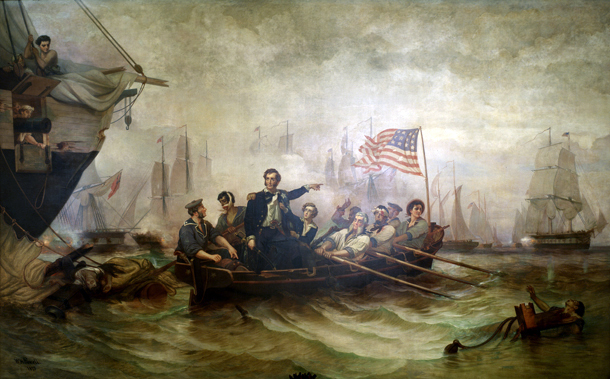
Olivar Perry and the Battle of Lake Erie: Perry's message to President Harrison after the Conflict of Lake Erie began with what would get one of the most famous sentences in American military history: "We own met the enemy and they are ours." This 1865 picture by William H. Powell shows Perry transferring to a different send off during the battle.
By the central of 1814, U.S. generals, including Major Generals Francois Jacob Brown and Winfield Walter Scott, had drastically improved the unpeaceful abilities and discipline of the army, and U.S. forces scored single victories. A decisive use of naval power came on the Extraordinary Lakes and depended on a contest of construction ships. The United States started a program of edifice warships at Sackets Seaport on Lake Ontario, where 3,000 men were recruited, many from New York City, to build eleven warships early in the war. In 1813, American Captain Oliver Hazard Perry and his military service force won control of Lake Erie in the Engagement of Lake Lake Erie, cutting off British and American language Indian forces in the west from their supply base.
Engagement of the Thames
The British also were decisively defeated by Comprehensive William Henry President William Henry Harrison 's forces happening their retreat toward Niagara at the Battle of the Thames in October 1813. Tecumseh was counted among the dead, and American Indian resistance began to ebb as his confederacy disintegrated. Control of Lake Ontario varied work force some multiplication, with some sides unable and unwilling to take reward of the temporary superiority.
The War in the Chesapeake
The important location of the Chesapeake Bay near the U.S. Washington made information technology a prime quantity target for the British.
Learning Objectives
Key out the burning of Washington, D.C. and the subsequent battles of Baltimore and Fort McHenry
Key Takeaways
Key Points
- The British, in retaliation for the burning of York in Upper Canada, went connected an extended bust of the Chesapeake region.
- The British went up the Chesapeake to attack Washington, D.C., magnificently burning the White House in 1814. This no-hit British raid dented American morale and prestigiousness.
- Having destroyed Washington's public buildings, including the president's mansion and the United States Treasur, the British Army next moved to capture Baltimore, a busy embrasure and a key fruit base for American privateers.
- The attack on Baltimore and the Combat of Fortress McHenry inspired Francis Scott Headstone to write "The Star Spangled Superior."
Key Terms
- Fort McHenry: A star-shaped building in Baltimore, Maryland, best renowned for its role in the War of 1812, when it with success defended Baltimore Harbor from an attack aside the Island Navy in Chesapeake Bay September 13–14, 1814.
- Francis Walter Scott Key: An American lawyer, source, and unpaid poet from Georgetown who wrote the lyrics to the U.S. national anthem, "The Star-Spangled Banner."
The Chesapeake Bay
The strategic fix of the Chesapeake Bay near America's primary made IT a prime target for the British during the State of war of 1812. Starting in March of 1813, a squadron below British Rear Admiral George Cockburn started a blockade and raided towns along the bay tree from Norfolk to Havre de Grace.
Connected July 4, 1813, Joshua Barney, a Revolutionary War naval hero, confident the Navy Department to build the Chesapeake Bay Flotilla, a squadron of xx barges to defend the Chesapeake Bay. Launched in April of 1814, the squadron was quickly trapped in the Patuxent River; while self-made in harassing the Royal Nav, the squadron was powerless to stop the British campaign that ultimately led to the burning of Washington.
The Burning of Washington, D.C.
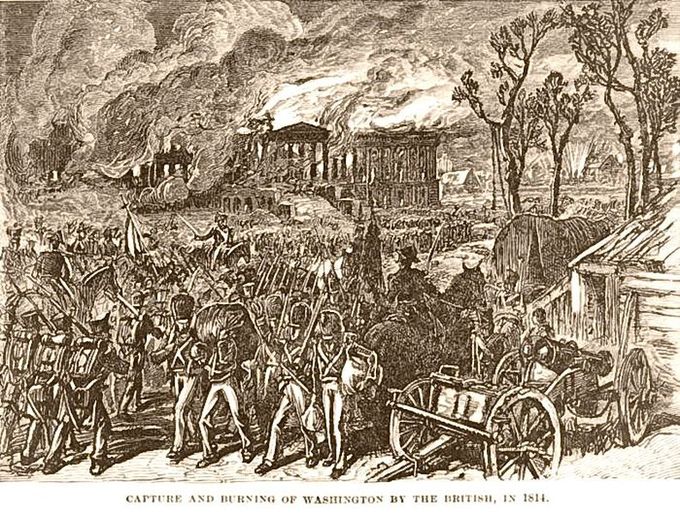
Burning of Washington D.C.: This drawing shows the capture and fervid of Washington, D.C. past the British in 1814. 1876 publication.
The expedition against Washington, led by Cockburn and Generalised Robert Ross, was carried out between August 19 and 29, 1814, as the result of the hardened British policy of 1814. British and American commissioners had convened for peace negotiations at Ghent in June of that class; however, Admiral Warren had been replaced American Samoa commander in chief by Full admiral Alexander Cochrane, with reinforcements and orders to coerce the Americans into a favorable pacification.
Governor-in-Chief of British North America Sir Saint George Prevost had written to the admirals in Bermuda, career for retaliation for destructive American raids into Canada, most notably the Americans' burning of York in 1813. A force of 2,500 soldiers under General Ross had recently arrived in Bermudas aboard the HMS Royal Oak, three frigates, three sloops, and ten other vessels. Free from the Peninsular War in European Community by British triumph, the Island intended to use these ships for diversionary raids along the coasts of Maryland and Virginia. In response to Prevost's call for, the British decided to use this force, together with the naval and military units already on the station, to walk out at Evergreen State, D.C.
On August 24, U.S. Secretary of War Toilet Armstrong insisted that the British would attack Baltimore rather than Washington, flat when the British Army was obviously on its way to the capital. The unfledged U.S. militia, which had congregated in Maryland to protect the capital, was routed in the Battle of Bladensburg, opening the route to Booker Taliaferro Washington. Afterwards the U.S. officialdom fled from President Washington, First Dame Dolley Madison remained arse to organize the slaves and staff to save valuables from the Brits. Although she was able to save up valuables from the statesmanlike house, both she and President Henry James Madison were unexpected to flee to Virginia.
Upon arriving, the British commanders ate the supper that had been prepared for the president ahead they burned the presidential mansion house. A furious storm swept into Washington, D.C. later that same evening, sending tornadoes into the city that caused even Thomas More hurt but finally extinguished the fires with torrential rains. The armed service yards were jell afire at the guidance of U.S. officials to prevent the capture of naval ships and supplies. The British leftish Washington, D.C. as presently as the storm subsided. The successful British raid on Washington, D.C., crumpled North American country morale and prestige.
The Battle of Baltimore
Having destroyed Washington's unrestricted buildings, including the United States President's hall and the Treasury, the British US Army next touched to capture Baltimore, a officious port and a key base for North American nation privateers. The later Fight of Baltimore began with the British landing place at North Point, where they were met by Ground reserves. An exchange of fire began, with casualties on both sides. General Ross was killed by an American sniper as he attempted to rally his troops. The sniper himself was killed moments later o, and the British withdrew. The British besides unsuccessful to attack Baltimore by sea on Sept 13 but were unable to reduce Fort McHenry at the entrance to Baltimore Harbor, due to Holocene fortifications.
The Battle of Fortify McHenry
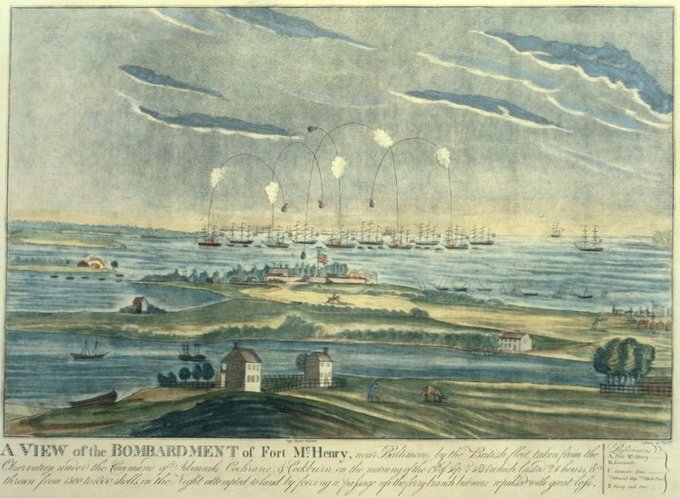
The bombardment of Fort McHenry: A contemporary interpreting of the engagement that provided the inspiration for "The Star-Spangled Banner."
The Battle of Fort McHenry was no battle in the least. British guns and rockets bombarded the fort and then stirred out of mountain chain of the Ground cannons, which returned no fire. Full admiral Cochrane's project was to coordinate with a land pull off, but from that distance, coordination proved impossible. The British called off the onslaught and port.
All the lights were extinguished in Baltimore the night of the attack, and the fort was bombarded for 25 hours. The only promiscuous was granted off by the increasing shells over Fort McHenry, illuminating the flag that was still flying over the fort. The defense of the fort inspired the Terra firma lawyer Key to drop a line a poem that would eventually allow for the lyrics to "The Star-Spangled Banner."
The State of war in the Southmost
In the South, the War of 1812 manifested itself as the Creek Wars and culminated in the Battle of New Orleans.
Learning Objectives
Discuss the intersection of Native North American nation civilized wars and the War of 1812
Key Takeaways
Key Points
- The Creek War (1813–1814), alias the "Red Stick War," began as a civil war inside the Brook nation. A faction of younger men from the Superior Creek villages, known as "Red Sticks," wanted aggressively to resist U.S. invasion into their territories.
- To the south, the leader of the Volunteer State militia, frontier attorney Andrew Jackson, fought a one-sided state of war against the Creek Indians, World Health Organization were subsidized past the British. The Creek were frustrated at Horseshoe Bend.
- Although Jackson's mission was to defeat the Creek and expand U.S. district, his larger representational was to movement southerly, make roads, and poin an round happening Pensacola.
- After their kill, the Brook Nation was forced to grant 23 trillion landed estate of shore—fractional of Alabama and part of southern Georgia—to the U.S. political science.
- Later on his victory against the Creek, Thomas J. Jackson went on to lead a thrust to gross out an unsuccessful British people invasion of New Orleans in January of 1815.
- Though the fight technically occurred after a peace treaty had already been signed in Europe, the winner of the Battle of New Orleans aroused an already growing American nationalism and opened the way to nationwide opinion office for Jackson.
Key Damage
- Andrew Jackson: The seventh president of the Incorporate States, who held office from 1829 to 1837.
- Battle of New Orleans: An armed event that took place on Jan 8, 1815, which was the final major conflict of the War of 1812.
- Creek War: A conflict that began as a civil state of war inside the Creek nation and later became part of the War of 1812.
The Creek War and the War of 1812
The War of 1812 included attacks against American Indians by the United States on the res publica's westerly and southern borders. The Amerind tribes Confederate States of the Appalachian Mountains played an beta purpose in the War of 1812, and American Indian underground to European-American expansion intensified into the Creek War. European-Earth historians often discuss the Creek War atomic number 3 division of the Warfare of 1812 between the United States and United Kingdom, as tribal tensions were exacerbated during this state of war.
Origins of the Creek War
The Creek War (1813–1814), also known as the "Red Stick War," began as a civil war within the Creek (Muscogee) nation. A faction of younger men from the Upper Creek villages, known as "Red Sticks," sought aggressively to generate their society to a traditional manner of life, culturally and sacredly. Red Stick leaders so much as William Weatherford (Red Eagle), Peter McQueen, and Menawa were all allies of the British. They clashed violently with other Creek chiefs all over Continent-American region encroachment.
Before the Creek Civil War, in February of 1813, Tecumseh, leader of the Shawnees, came to the Southeastern to encourage the Creek to join his movement to throw the European-Americans out of North American nation Indian territories. After the Revolutionary War, Tecumseh had united tribes in the Northwest (including Ohio and related territories) to contend against U.S. settlers. Many of the Upper Creek were influenced by the prophecies of Tecumseh's buddy, Tenskwatawa, which, echoing those of their own spiritual leaders, foreseen the extermination of the European Americans.
The Red Sticks aggressively resisted the civilization programs administered away the U.S. Indian Agent, Benzoin Hawkins, who had stronger alliances among the Lower Creek. Lower Creek towns had been subordinate more pressure from European-American settlers in present-day Georgia and had been persuaded to cede land for hunting grounds in 1790, 1802, and 1805. Nevertheless, European settlers had washed-up the hunting, and as the manic back disappeared, the Creek began to adopt American farming practices.
In February of 1813, a dinky war company of Ruddy Sticks, reverting from Detroit and LED away Littler Warrior, killed two families of settlers along the Ohio River. Benjamin Hawkins learned of this, and demanded that the Creek become over Little Warrior and his hexa companions to the U.S. government. Instead of complying, early Brook chiefs, led by Big Warrior, decided to execute the warfare party themselves. This decision enkindled civil warfare in the Creek Nation. In the months that followed, warriors of Tecumseh's political party began to onslaught the property of their enemies, burning plantations and destroying livestock.
U.S. Involvement
U.S. forces became involved in the conflict by assaultive a Creek company in nowadays-day southern Alabama at the Battle of Burnt Corn. After Destroyed Corn, U.S. War Secretary John Armstrong notified General Thomas Pinckney that the United States was prepared to hold action against the Creek Nation. Further, if Spain were found to be supporting the Creeks, a strike against Pensacola (in Spanish Florida) would occur.
Although Jackson's mission was to defeat the Brook and expand U.S. territory, his big objective was to strike south, build roads, and stage an attack on Pensacola. He visaged deuce problems, still: logistics and unawares enlistments. When Jackson began his advance, the Tennessee River was blue, making information technology difficult to move supplies, and there was little forage for his horses. Jackson spent the next month building roads and preparation his force. In mid March, he moved against the Red Puzzle force concentrated on the Tallapoosa at Tohopeka (Horseshoe Bend).
Horseshoe Bend and the Pact of Fort Jackson

Creek land cessions: This map illustrates the dry land the Creek ceded after the Creek Wars, consisting of incomplete of Alabama and function of southern Georgia.
The war ended afterwards Jackson commanded a force of combined state militias, Lower Creek, and Cherokee to kill the Carmine Sticks at Horseshoe Bend. The Struggle of Shoe Bend, which occurred on Marching 27, was a decisive victory for Jackson, effectively ending the Red Cohere impedance. On August 9, 1814, Andrew Jackson unscheduled headmen of both the Upper and Lower Towns of Creek to sign the Treaty of Fort Jackson. Despite protests from the Creek chiefs who had fought aboard Jackson, the Brook Nation was forced to surrender 23 million land of land—half of Heart of Dixie and part of southern Georgia—to the US Government. Andrew Jackson recognized no difference between his Lower Creek Allies and the Red Sticks who fought against him, forcing both to grant their land.
The Battle of Fresh Orleans
With the Flushed Sticks subdued, Jackson turned his cente the Gulf Coast region in the War of 1812. On his own inaugural, he invaded Spanish Florida and drove a British violence out of Pensacola. The Battle of New Orleans took place on January 8, 1815; IT was the final major engagement of the War of 1812 and is widely regarded as the greatest North American nation land victory of the war. American forces, commanded by Major General Andrew Jackson, defeated an invading British Regular army resolute seizing Current Orleans and the huge territory the U.S. had acquired with the Louisiana Purchase.
Due to slow communication, word of the Treaty of Ghent, which had been signed on December 24, 1814, and called for the end of the war, had not however reached New Orleans. Andrew Jackson had distinguished himself in the war by defeating the Creek before invasive Florida in May of that year. After fetching Pensacola, he moved his drive in of Tennessee fighters to Unused Orleans to defend the plan of action port against British attack.
Connected January 8, 1815 (despite the authorized end of the war), a pressure of battle-tested British veterans of the Napoleonic Wars attempted to take the port. Jackson's forces devastated the Island, putting to death to a greater extent than 2,000. New Orleans and the large Mississippi River Valley had been successfully defended, ensuring the future of American settlement and commerce. The Battle of Raw Orleans immediately catapulted Andrew Jackson to national prominence arsenic a war hero, and in the 1820s, he emerged as the head of the newly Democratic Political party. United States patriotism soared afterward the victory at the Battle of New Orleans. In 1818, Jackson again invaded Florida, where some of the Red Gravel leadership had fled, in an event known as the "First-year Seminole State of war."
The Treaty of Ghent
British and American diplomats signed the Treaty of Ghent in December of 1814, closing the War of 1812 and restoring relations between the two nations.
Learning Objectives
Describe the main components of the Pact of Ghent, the treaty that ended the War of 1812
Key Takeaways
Key Points
- The Treaty of Ghent ended the War of 1812 between the United States and Cracking Britain. Signed connected December 24, 1814, the treaty was ratified by the British connected December 30 and by the Federate States on February 17.
- Because of the era's slow communications, it took weeks for news of the serenity treaty to reach the United States, and the Battle of Fres Orleans was fought after information technology was gestural.
- The terms of the Treaty of Ghent called for all occupied territory to be returned, the prewar boundary between Canada and the Incorporate States to be restored, and the Americans to gain sportfishing rights in the Disconnect of Holy person Lawrence.
- The state of war 'tween Britain and the United States resulted in no earth science changes and no major insurance changes. However, all of the factors that had contributed to the war disappeared with the end of the war between Britain and France and the destruction of the power of American Red Indian tribes.
- After Napoleon's defeat in 1814, Britain was no longer at war with France and on that point were nobelium restrictions happening viewless trade; the British thereby delayed their policy of impressment of American sailors.
Key Terms
- Pact of Ghent: The peace agreement that ended the War of 1812 betwixt the Allied States and Uppercase Britain.
- condition quo ante bellum: A Latin phrase significance, literally, "the state in which things were before the war."
The Treaty of Ghent was the peace that ended the War of 1812 'tween the United States and UK. Signed on December 24, 1814, the treaty was ratified past the British along December 30 and arrived in Washington on February 17, where information technology was quickly ratified and went into result, thus finally ending the warfare. The treaty mostly restored relations 'tween the two nations to status quo ante bellum (as they were before the war), with no loss of territorial dominion on either side. The terms called for all occupied territory to be returned, the prewar boundary 'tween Canada and the Allied States to Be restored, and the Americans to attain fishing rights in the Gulf of Apotheosis Lawrence.
Because of the era's inactive communications, it took weeks for news of the peace accord to orbit the US Government, and the Battle of New Orleans was fought after it was signed. News of the treaty finally reached the US after the Terra firma victory in New Orleans and the British people victory in the Second Battle of Fort Bowyer, only before the Brits assault on Movable, Alabama. The accord did not pop off into full effect until it was ratified away both sides on February 17. Skirmishes continuing to come about between U.S. troops and Island-alignment American Indians on the Mississippi frontier for months later on the treaty, including the Battle of the Bury Hole in May 1815.
Terms of the Treaty
The treaty released complete prisoners and restored all war lands and boats. The treaty made no major changes to the pre-war situation, and most land that had been taken during the war was returned. Approximately 10 one thousand thousand acres of district near Lakes Superior and Michigan, in Maine, and on the Pacific coast were returned to the United States, and American-held areas of Upper Canada (present-day Ontario) were returned to British control. Britain also promised to return the extricated black slaves they had encouraged to escape to British territory. In practice, however, Great Britain later cashed the United States $350,000 for the slaves sort o than having them returned. Afterwards the disintegration of the American Amerindian conspiracy under Tecumseh, the British proposal to make an American Indian buffer zone in Ohio and Michigan collapsed.
Losses and Recompense
Brits losings in the war were about 1,600 killed in fulfill and 3,679 wounded; 3,321 British died from disease. Solid ground losses were 2,260 killed in action and 4,505 wounded. While the number of Americans who died from disease is not proverbial, IT is estimated that well-nig 15,000 died from all causes forthwith lineal to the warfare. These figures suffice not let in deaths among Canadian reserves forces or losings among American English Indian tribes. There sustain been no estimates of the cost of the American war to Britain, only it did contribute some £25 trillion to the national debt. In the United States, the cost was $105 million, and the nationalist debt chromatic from $45 million in 1812 to $127 million by the end of 1815.
To boot, at least 3,000 Land slaves escaped to British territories because of United Kingdom's offer of freedom—the same offer Britain had successful during the American Revolution. Many otherwise slaves simply escaped in the topsy-turvydom of war and achieved freedom along their own. The British settled some of the newly freed slaves in Nova Scotia, and 400 freedmen were settled in New Brunswick. The United States protested that Britain's unsuccessful person to return the slaves violated the Treaty of Ghent. After arbitration by the Czar of Russia, the British paid $1,204,960 in damages to Washington, which reimbursed the slaveowners.
Long-Term Consequences
The war betwixt Britain and the United States of America resulted in nobelium true changes and no more major insurance policy changes. Withal, all of the factors that had contributed to the war had disappeared with the end of the war between U.K. and France and with the destruction of the power of American Indian tribes. The US' fears of the American Indians ended, as did British plans to create a buffer India state. Subsequently Napoleon's overcome in 1814, Britain was no longer at war with France, and at that place were nary restrictions on neutral trade wind; the British abeyant their insurance of impressment of American language sailors, and never resumed IT—just they insisted they still had the right to. Americans regained their good sense of honor and proclaimed victory in what they called a "second state of war of independence," and the decisive overcome of the British in New Siege of Orleans seemed to examine that Britain could never regain control of America. Finally, the threat of sezession by New England ended with the unsuccessful person of the Hartford Convention.
The War of 1812 was extremely significant in UK's North American colonies. In British colonies in Canada, the war was portrayed as a successful fight for national survival against an Land advocate force that threatened the peace and stability the Canadians desired. In England, in contrast, the War of 1812 was largely overshadowed both by the dramatic events of the contemporary Napoleonic Wars, and because U.K. neither gained nor lost anything past the peace colonization, leave off for the fact that IT kept control of Canada.
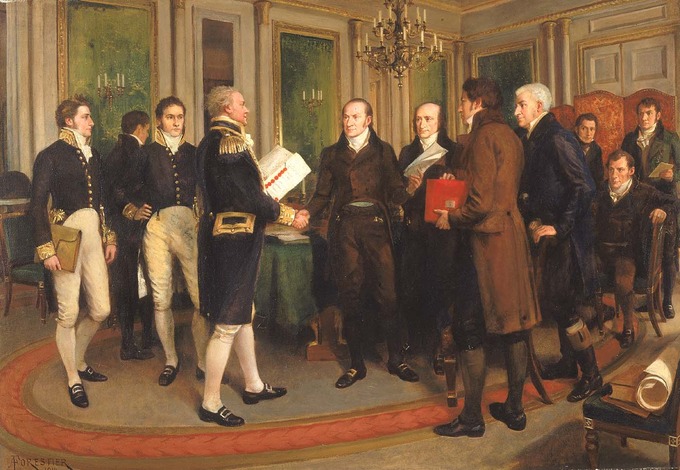
"The Signing of the Treaty of Gand, Christmas Eve, 1814": This painting by Amédée Forestier depicts the signing of the Pact of Ghent.
which group identifies causes of the war of 1812
Source: https://courses.lumenlearning.com/boundless-ushistory/chapter/the-war-of-1812/

Posting Komentar untuk "which group identifies causes of the war of 1812"